How to spot fake job applicants: 6 signs of candidate fraud from 600+ fakes we caught, and how Clera flags them before your first interview.
Fake job applicants are now part of hiring for any remote role. Gartner expects 1 in 4 candidate profiles worldwide to be fake by 2028, and the US Department of Justice says North Korean IT workers were hired by more than 100 US companies through remote roles.
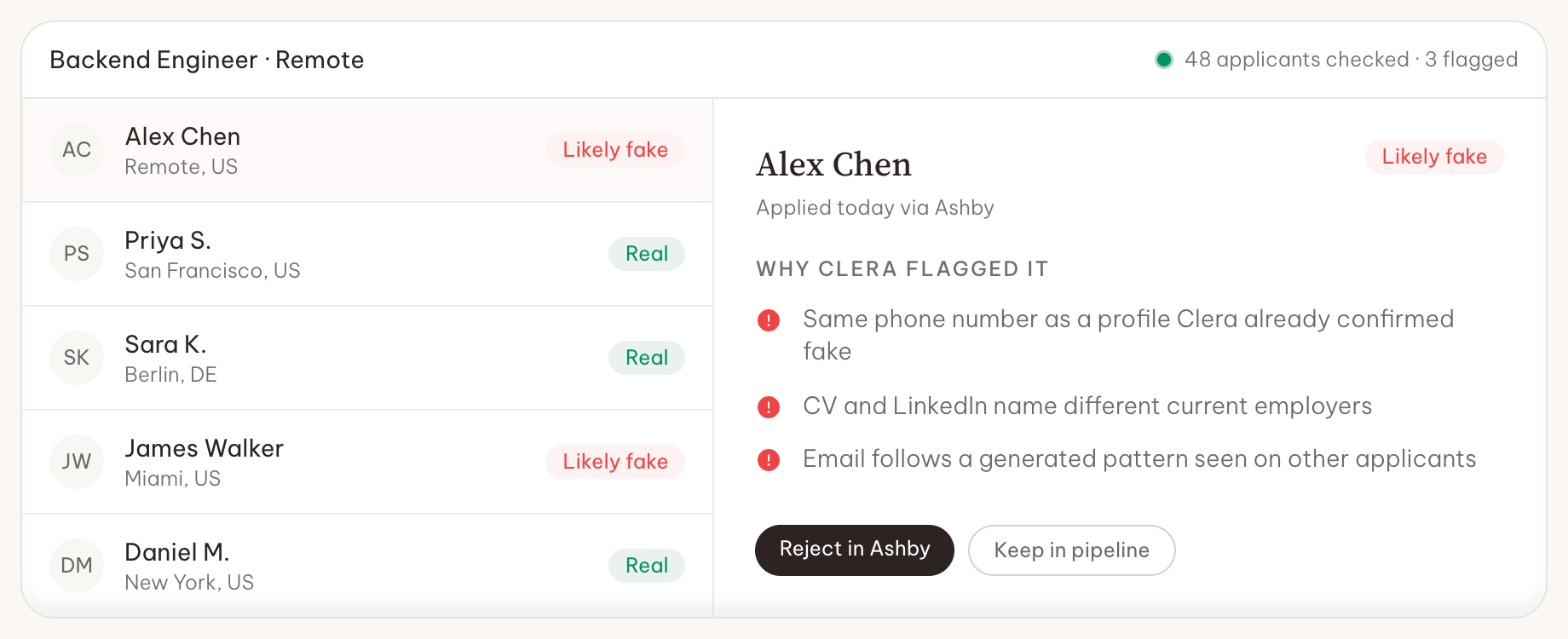
Today we're launching Fake Candidate Detection. Clera checks every applicant in your Ashby, Workable or Lever pipeline against 240,000+ candidates and 600+ fakes we've already caught. If something is off, you see a flag and the evidence before anyone books a call. No passport uploads, no selfies. Real candidates never notice it's running.
What is candidate fraud?
Candidate fraud is when a job applicant lies about who they are, not just what they've done: a made-up or stolen identity, one person applying under several names, or a different person showing up to the interview. It clusters on remote engineering roles, where nobody meets in person until the offer. The cost isn't only a bad hire. It's every hour your engineers spend interviewing someone who doesn't exist. In Gartner's survey of 3,000 job seekers, 6% admitted to interview fraud, either posing as someone else or having someone else pose as them.
How to spot a fake job applicant: 6 signs
We've been flagging fake profiles since May 2025. After 600+ confirmed cases, these are the signs that keep coming back.
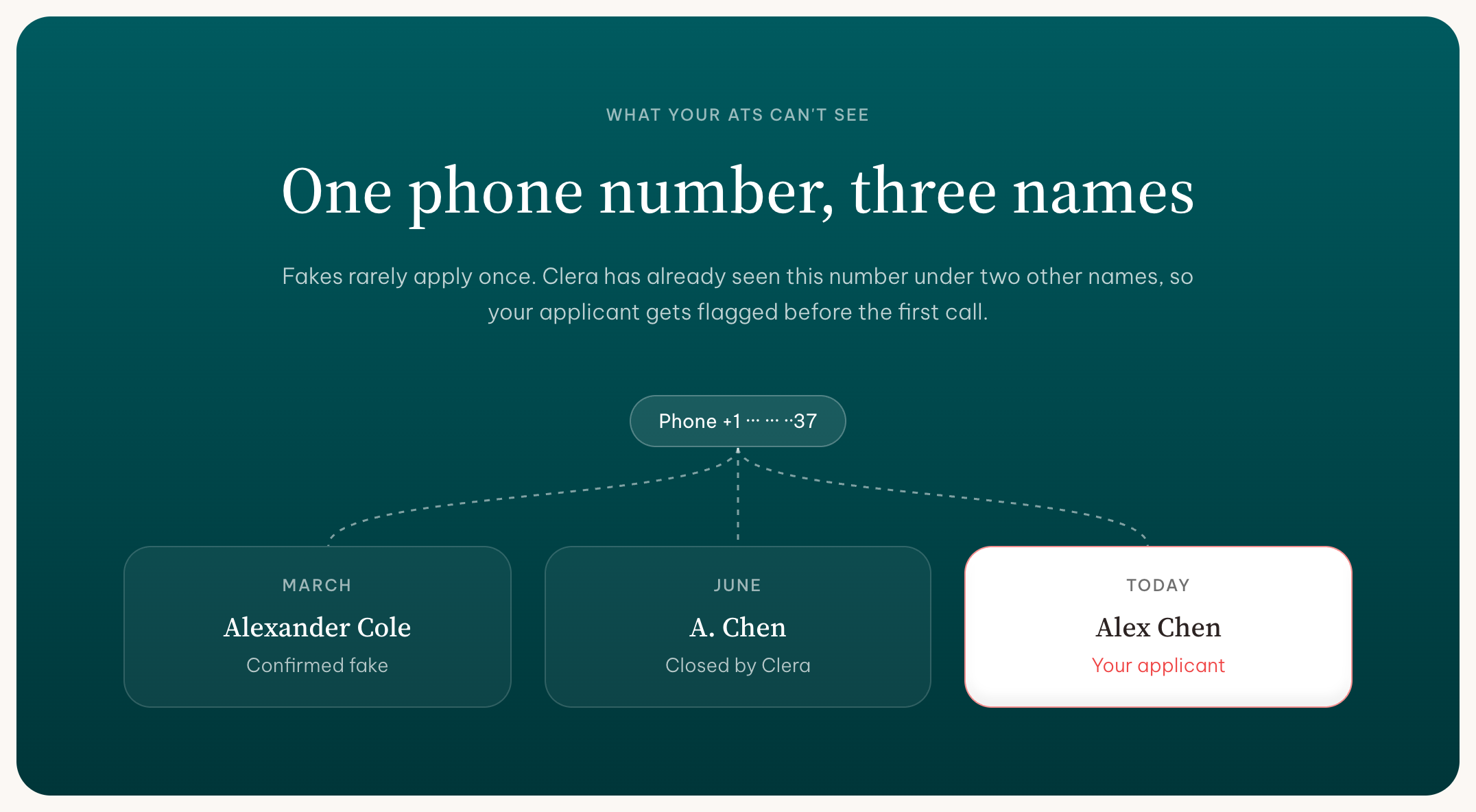
1. One phone number, several names
Fakes rarely apply once. The same phone number or email turns up under different names, weeks or months apart. Inside one company's pipeline that's easy to miss. Across 900+ startups it's hard to hide.
2. A job that started before the company did
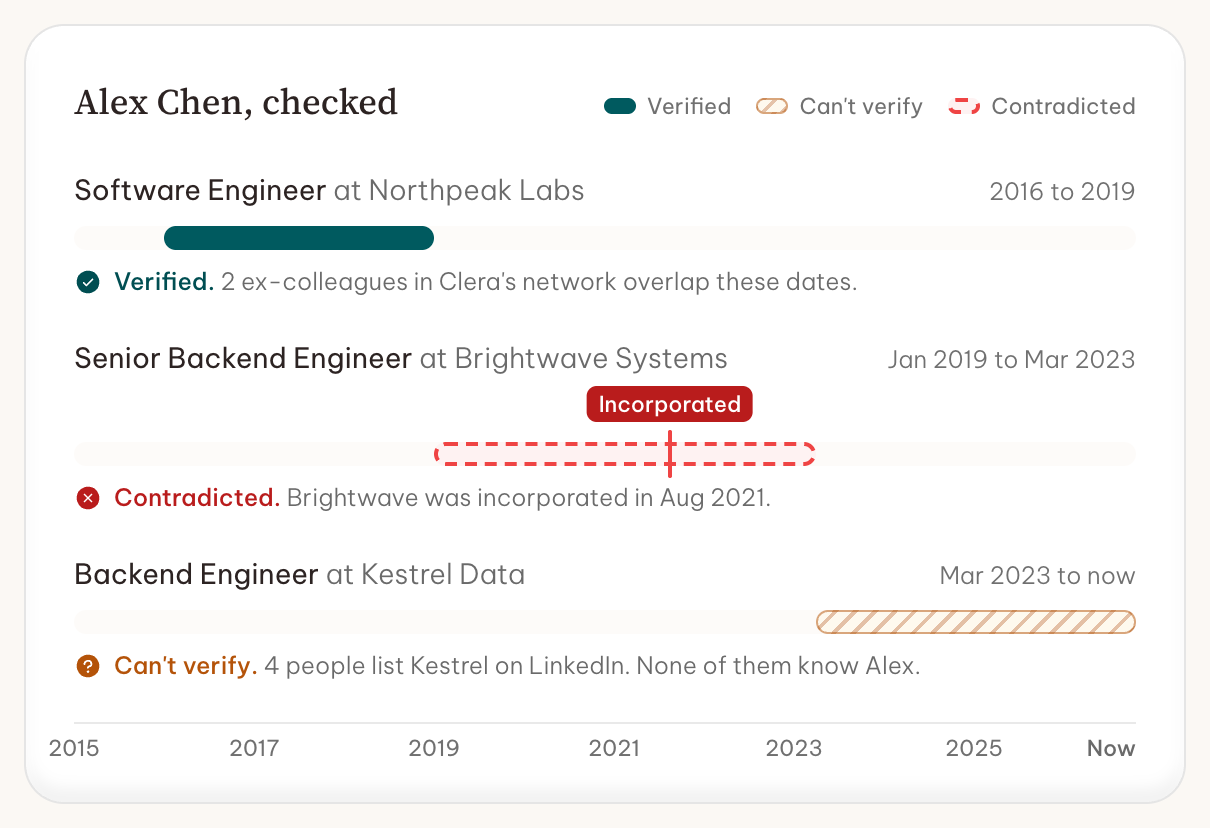
Line up every job on the CV against LinkedIn, company filings and the people who worked there. A role that began in 2019 at a company incorporated in 2021 doesn't add up. A job where two ex-colleagues overlap the same dates does.
3. Tech that didn't exist yet
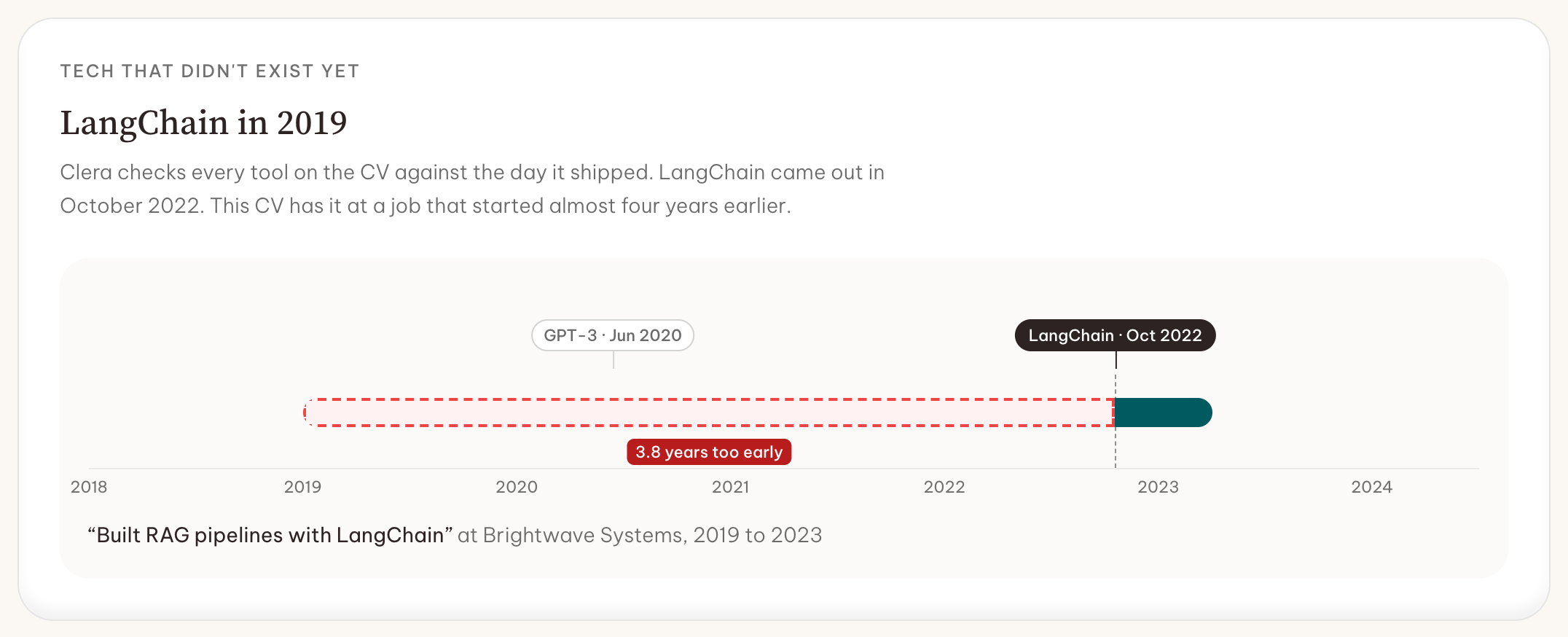
LangChain came out in October 2022. A CV that says "built RAG pipelines with LangChain" at a job from 2019 is claiming it almost four years early. People round their dates. They don't adopt a framework before its authors wrote it.
4. Contact details and profiles that don't add up
An email that follows a pattern seen on other fakes. A CV and LinkedIn that name different current employers. A LinkedIn link that goes nowhere, or a profile created last month with a full career already on it.
5. Another employer already reported them
When a company tells us a candidate was fake, that person gets flagged on their next application to anyone else on Clera. Typical reports: a different person showed up on the video call, or the same CV arrived under another name.
6. No footprint beyond the CV
Check company registries, GitHub, personal sites and alumni directories. A GitHub account created seven weeks ago proves nothing alone. Next to a contradicted job, it tells a story. Clera runs this second look automatically before any flag reaches you.
Why one sign is never enough
Any single sign can have an innocent reason. People share family phones. Recruiters make typos. Flag on one weak signal and you'll insult good candidates.
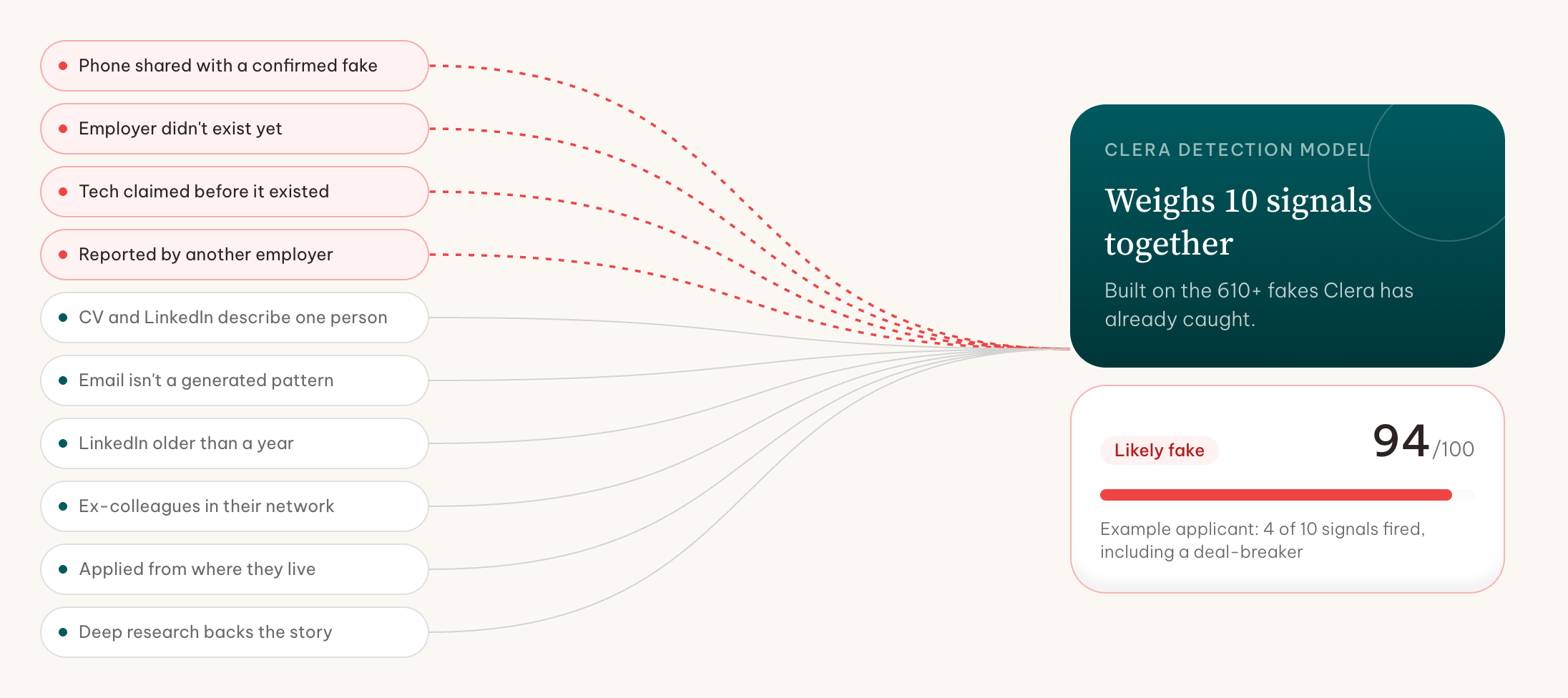
Clera's detection model weighs 10 signals together and only flags an applicant when they add up. A few are deal-breakers on their own, like a phone number shared with a confirmed fake. The rest only count in combination.
Why your ATS misses repeat fakes
A fraud check inside an ATS compares your applicants with each other. When the same fake applied to three other startups last month under a different name, your ATS sees a brand new person. Clera remembers every fake it has caught, so they get flagged on their first application to you, not their fifth. Caught once, flagged everywhere.
How Clera's candidate fraud detection works
- Connect Ashby, Workable or Lever. On something else? Send applicants over on a call.
- Clera checks each applicant the moment they apply. No batch runs, no backlog.
- You see the flag and why. Likely fake, worth a look, or looks real, with the exact signals next to it. You decide what happens next.
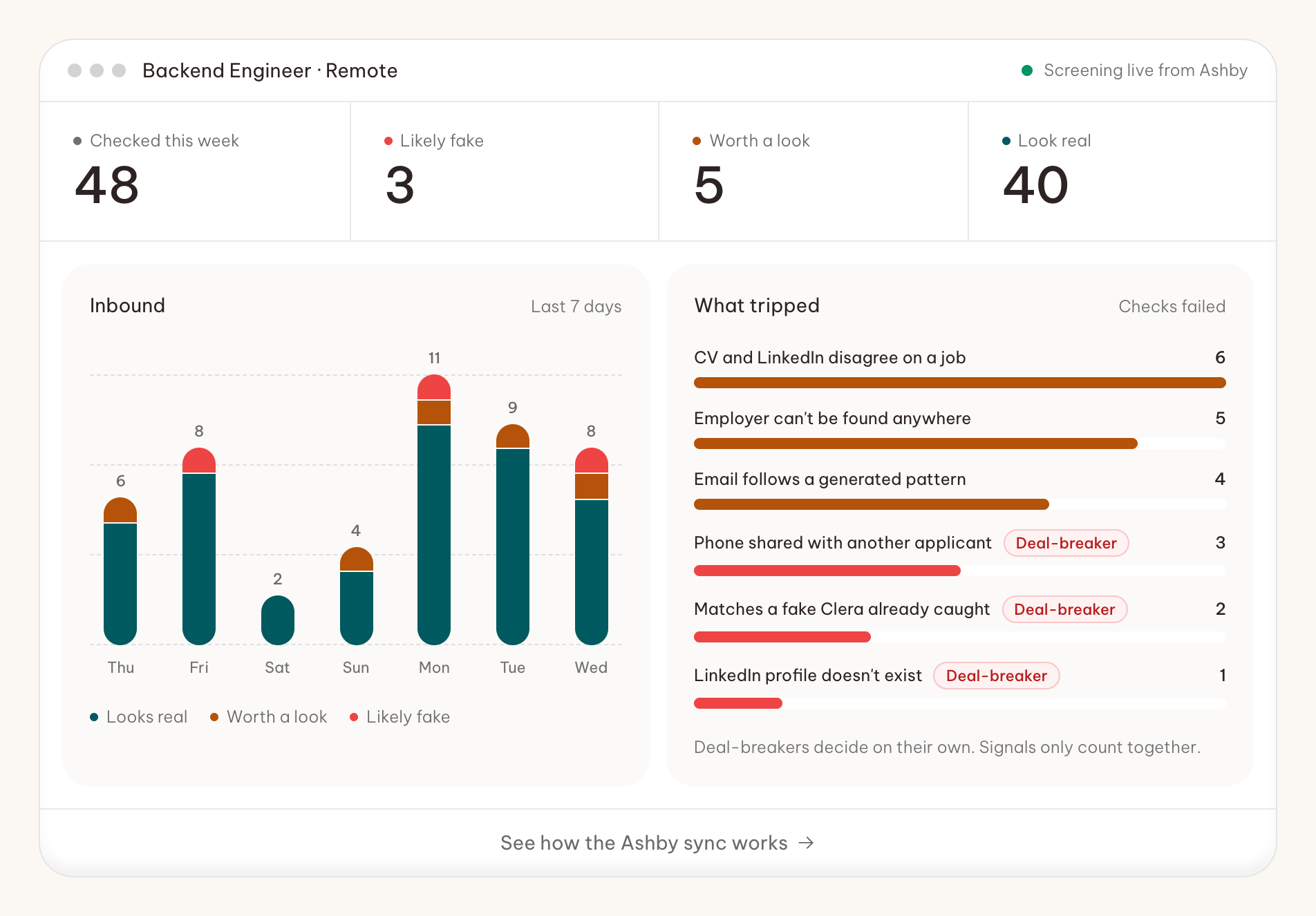
A good recruiter could run some of these checks by hand. Nobody does it for 48 applicants on a Tuesday afternoon, and no recruiter can check a phone number against fakes caught at other companies.
The same check runs in the Clera dashboard, in Claude through Clera's MCP, and over an API. Comparing hiring tools more broadly? See our roundups of the best AI recruiters for startups and the best recruiting agencies for startups.
Real candidates never feel suspected
Clera never rejects anyone on its own. It flags an applicant, shows the evidence, and leaves the decision with you. Because every flag comes with its reasons, a wrong one is easy to spot: you're looking at an incorporation date and a phone number, not a black-box score.
Good applicants do nothing extra. No ID upload, no selfie video, no extra form. That matters when you're competing with every other startup for the same engineers.
Frequently Asked Questions
Look for signs that stack up: contact details used under other names, a job that started before the company existed, tools claimed before they shipped, a CV that disagrees with LinkedIn, and almost no footprint online. One sign is usually innocent. Three together usually aren't.
Check applicants before the first call, not after the offer. Compare the CV with LinkedIn and company records, and check contact details against fakes you've already caught. Clera does both automatically on every applicant from your ATS.
It's when the person on the call isn't the person who applied, or someone feeds them answers. The cheapest place to stop it is before the call, by catching the fake profile behind it.
No. You decide what happens to every flagged applicant. If we get one wrong, tell us and we reverse it.
Bring a candidate you're unsure about
Book 15 minutes. We'll run the check on that candidate together, live.