AI-generated applications are a startup hiring challenge. Learn to detect synthetic candidates and build an authentic strategy with Clera.
Solving the Synthetic Candidate Problem: Authenticating Startup Applications in the Age of AI
You've posted a job, eager to find your next superstar. Applications flood in, but some aren't what they seem. Thanks to generative AI, that perfect resume and cover letter might not be from a real person. It could be a meticulously constructed digital phantom.
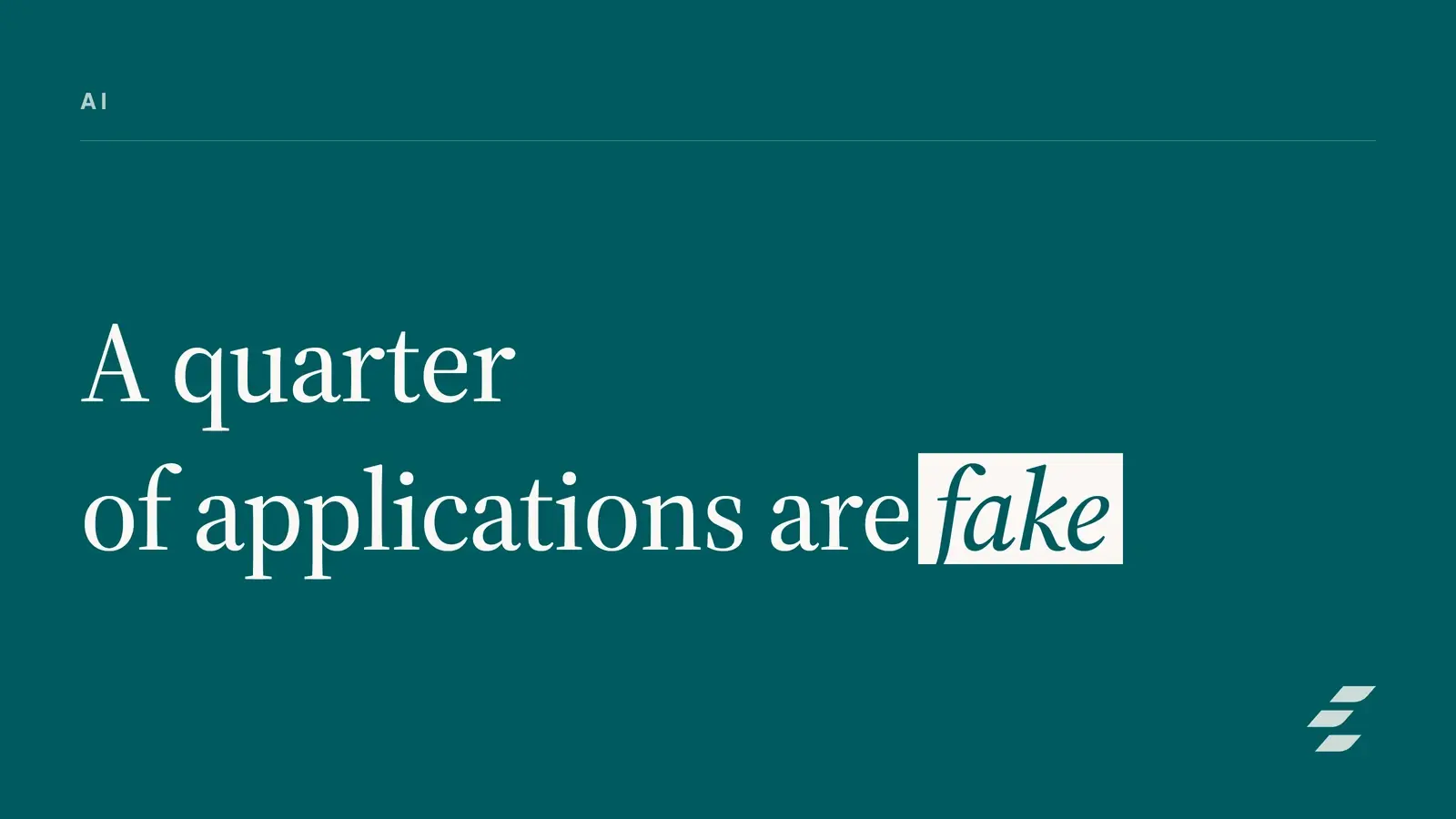
This is the Synthetic Candidate Problem. It costs startups like yours valuable time, money, and risks bad hires. Your small team might sort through hundreds of applications, only to find some estimates suggest as high as 25-30% are fake or AI-enhanced. This wastes time better spent on interviews and strategic growth – time your early-stage company can't afford to lose.
This article shares practical strategies and innovative approaches to authenticate applications. You'll learn to spot red flags, use technology for verification, and build robust processes. Protect your hiring from AI deception. Reclaim efficiency and connect with real talent to drive your startup forward.
What is the Synthetic Candidate Problem and Why Does it Matter for Startups?
For startups, every hire is crucial. But what if the candidates you're evaluating aren't entirely real? This is the core of the synthetic candidate problem: hiring teams struggle to tell human-made job applications from those significantly enhanced or entirely generated by artificial intelligence. It's a critical hurdle that demands a proactive and authentic hiring strategy.
The Rise of AI in Job Applications
Generative AI has dramatically reshaped job applications. Tools like ChatGPT are now common. A 2024 survey found that 75% of job seekers use AI tools like ChatGPT for applications, including resumes and cover letters (ResumeBuilder.com Survey, January 2024). This means many resumes and cover letters you receive are AI-polished and keyword-rich, making them incredibly hard to tell from truly authentic submissions.
This flood of AI-generated applications creates a 'noise' problem. Recruiters are already swamped. Over 60% of recruiters worry about application authenticity due to AI content, making it harder to find real skills and experiences (Gartner HR Research, Q1 2024). Resumes get less than 7 seconds of review time (The Ladders, 2024 update). AI exploits this, crafting documents that pass initial checks, potentially leading you to interview candidates who lack the claimed skills. As Josh Bersin, Global Industry Analyst, says, "The 'synthetic candidate problem' isn't just about detecting AI; it's about re-evaluating what 'authenticity' means in a digital age." Forbes, 'AI in HR: The Good, The Bad, and The Ugly', March 2024
Unique Challenges for Early-Stage Companies
For startups, the synthetic candidate problem is more than an HR issue; it's a serious threat. Unlike larger enterprises with extensive HR departments, early-stage companies operate with lean teams and limited resources. Every single hire is hugely important, shaping your culture, product, and future. A bad hire, especially one based on a fake AI profile, can be devastating, draining valuable time, capital, and morale.
This amplifies startup recruitment challenges. You need skilled people who fit your mission, adapt well, and can truly solve problems. These qualities are hard to see on a perfectly crafted AI resume. Your authentic hiring strategy must focus on finding these real abilities.
Here’s why it matters critically for you:
- High Stakes: A single bad hire can stop your startup's progress, waste money, and hurt team morale. You can't afford to train someone whose skills were mostly AI-made.
- Limited Resources: Startups often don't have money for deep background checks or complex AI Detection Tools. Your hiring process must be strong and efficient by design.
- Culture is Key: Real hires build a strong, cohesive team culture. AI applications can hide a poor cultural fit, causing internal friction and slowing your growth.
Companies like Linear use take-home assignments and live coding challenges for technical roles. This filters out AI-reliant candidates, as they must show real problem-solving and coding skills in realistic settings. Stripe also uses a tough multi-stage process, focusing on how candidates think and solve problems, not just what they claim. These methods are vital for finding real talent.
How AI is Reshaping the Talent Landscape
Beyond strong hiring processes, it's vital to understand how AI fundamentally changes talent acquisition. For startups, where every hire is key, navigating this new landscape requires both vigilance and strategic adaptation.
The Double-Edged Sword of AI in Hiring
AI in HR is a classic double-edged sword. It brings incredible efficiency. Tools like Greenhouse and Lever use AI to screen candidates, automate scheduling, and manage pipelines. This saves founders and hiring managers valuable time. By 2025, AI is projected to be in over 80% of HR software solutions (Deloitte Human Capital Trends, 2024), promising even greater operational gains. This is the "good" side of AI in HR.
But this efficiency has a big challenge: more AI-generated content from candidates. A 2024 survey found that 75% of job seekers use AI tools like ChatGPT for applications, including resumes and cover letters (ResumeBuilder.com Survey, January 2024). This creates too many optimized applications, making it harder for startups to find real talent. As Josh Bersin, a global industry analyst, says, "The 'synthetic candidate problem' isn't just about detecting AI; it's about re-evaluating what 'authenticity' means in a digital age." Forbes, 'AI in HR: The Good, The Bad, and The Ugly', March 2024
Masking True Capabilities: The AI Resume Effect
Startups worry that AI creates perfect applications that match job descriptions, potentially hiding real skills. These AI documents exploit the fact that resumes get less than 7 seconds of review time (The Ladders, 2024 update). They often pass initial checks even if skills are missing. This makes it incredibly hard to tell real skills and experiences from AI-made ones.
Over 60% of recruiters worry about application authenticity due to AI content, making it harder to find genuine candidate skills (Gartner HR Research, Q1 2024). Startups like Linear reduce this risk by using take-home assignments and live coding challenges, forcing candidates to show real problem-solving abilities. But if you rely heavily on resume screening, the risk of hiring someone whose AI-enhanced application exaggerates their capabilities is significant. Dr. Peter Cappelli from The Wharton School advises, "If your hiring process can be gamed by ChatGPT, it's not robust enough." Wharton Business Daily, 'AI and the Future of Work', February 2024
Key Actions for Startups:
- Prioritize Skills-Based Assessments: Don't just look at resume keywords. Use live coding challenges, take-home projects, or case studies. Make candidates show their skills, not just claim them. See effective skill assessment strategies.
- Structured Behavioral Interviews: Create interviews that explore past actions and critical thinking. Look for specific examples and real problem-solving methods that AI struggles to fake.
- Use Video Introductions: Ask for short video responses. This helps you see their communication style and authenticity, making it harder for pure AI-generated content to pass.
- Thorough Reference Checks: Don't just verify employment. Ask past managers specific questions about performance, problem-solving, and teamwork.
Building an Authentic Hiring Strategy: Beyond the Resume
To truly find top talent, your hiring strategy must go beyond the resume. Beyond video intros and reference checks, advanced AI tools mean startups must rethink how they find real talent. The hiring landscape has changed, making an authentic hiring strategy more vital than ever.
Re-evaluating Authenticity in a Digital Age
The traditional resume is now less reliable. 75% of job seekers use AI tools like ChatGPT for applications (ResumeBuilder.com Survey, January 2024), blurring the line between human and AI content. This creates what industry analyst Josh Bersin aptly calls the "synthetic candidate problem." As Bersin notes, "The 'synthetic candidate problem' isn't just about detecting AI; it's about re-evaluating what 'authenticity' means in a digital age. Startups must shift from keyword matching to genuine Skill Validation and human connection." Forbes, 'AI in HR: The Good, The Bad, and The Ugly', March 2024
Recruiters are already struggling. Over 60% worry about application authenticity due to AI (Gartner HR Research, Q1 2024). Resumes get less than 7 seconds of review time (The Ladders, 2024 update), letting AI-optimized resumes pass easily and potentially missing real candidates. For early-stage companies where every hire is critical, relying solely on keyword matching is a risky game.
Designing Robust Assessments
To fight this, focus on how candidates think and solve problems, not just what they claim. This is where true skill validation comes into play. As Dr. Peter Cappelli, Professor of Management at The Wharton School, advises, "If your hiring process can be gamed by ChatGPT, it's not robust enough. Design tasks that require critical thinking, creativity, and real-world application, not just regurgitation." Wharton Business Daily, 'AI and the Future of Work', February 2024
Here’s how to build a more robust process:
- Implement Real-World Challenges: Go beyond theory. Companies like Linear and Stripe use take-home assignments and live coding challenges for technical roles. This makes candidates show real problem-solving skills in realistic settings, making it almost impossible for AI claims to pass without true ability. Learn about designing effective take-home assignments.
- Structured Behavioral and Situational Interviews: Design interviews with specific, open-ended questions about past actions and hypothetical situations. Rippling uses a highly structured hiring process with clear rules and multiple interviewers. This reduces bias and gives a full view of candidates, valuing work samples over resume keywords. Look for detailed examples, critical thinking, and real problem-solving that AI struggles to fake.
- Focus on Problem-Solving Scenarios: For non-technical roles, give candidates complex business problems relevant to your startup. Ask them to explain their thinking, solutions, and how they'd measure success. This shows their analytical skills, strategic thinking, and adaptability, offering real candidate verification beyond a polished resume.
Practical Steps to Authenticate Candidates and detect AI resumes
Now, let's look at practical steps to authenticate candidates and spot AI resumes. Generative AI has changed hiring. It's harder than ever to assess real skills from just a resume. A 2024 survey found that 75% of job seekers use AI tools like ChatGPT for applications, including writing resumes and cover letters (ResumeBuilder.com Survey, January 2024). Founders need a proactive plan to detect AI resumes and ensure strong candidate verification. As Josh Bersin, Global Industry Analyst, says, "The 'synthetic candidate problem' isn't just about detecting AI; it's about re-evaluating what 'authenticity' means in a digital age. Startups must shift from keyword matching to genuine skill validation and human connection." Forbes, 'AI in HR: The Good, The Bad, and The Ugly', March 2024
Here are practical steps to build a resilient hiring process:
Implementing Skills-Based and Experiential Assessments
Go beyond traditional resume screening. Use skills-based assessments that require candidates to show their abilities. For technical roles, use live coding challenges or take-home projects like your team's real tasks. For non-technical roles, try case studies, strategic planning exercises, or short take-home assignments. This naturally filters out AI-reliant candidates, as they must prove their problem-solving abilities and proficiency.
- Actionable Insight: Learn from companies like Linear, which uses take-home assignments and live coding challenges for engineers to ensure they can do the job. Stripe also uses "work sample" projects to see how candidates think and solve problems, not just what they claim. Dr. Peter Cappelli of The Wharton School advises, "If your hiring process can be gamed by ChatGPT, it's not robust enough. Design tasks that require critical thinking, creativity, and real-world application, not just regurgitation." Wharton Business Daily, 'AI and the Future of Work', February 2024
Mastering Behavioral and Situational Interviews
After verifying basic skills, use structured behavioral interviews. These explore real problem-solving, critical thinking, and how candidates handle real situations. Instead of asking "Are you a team player?", ask "Tell me about a big project challenge. What did you do, and what happened?" Look for detailed, specific examples that show their thinking, resilience, and teamwork.
- Actionable Insight: Create consistent questions for each role, focusing on past actions and hypothetical situations relevant to your startup. This helps with fair comparisons and makes AI-coached answers less convincing. Jeanne Meister, EVP of Future Workplace, stresses, "Relying solely on resume screening in the age of generative AI is a dangerous game. Focus on live problem-solving and behavioral interviews to truly understand a candidate's capabilities and cultural fit." HR Executive, 'Navigating the AI-Powered Talent Landscape', April 2024
The Power of Thorough Reference Checks
Don't ignore strong reference checks. Go beyond just verifying employment. Talk to past managers or colleagues. Ask specific, open-ended questions about the candidate's performance, problem-solving, and teamwork. Ask about their strengths, weaknesses, and how they handled specific challenges.
- Actionable Insight: Ask references to confirm specific claims from interviews or resumes. If a candidate mentioned leading a particular project, ask the reference about their role and impact. This cross-checking is a crucial layer of candidate verification. It confirms authenticity and gives a full view of their skills, making AI-made claims much harder to hide. See Best Practices for Reference Checks.
Leveraging Technology and Tools for Smarter Verification
Beyond traditional methods, technology offers powerful ways to verify candidates. Beyond traditional reference checks, modern hiring needs smart use of technology. This ensures you verify real skills, not just polished presentations. For startups, where every hire is pivotal, the right recruiting tools mean accuracy and less risk from complex applications, not just efficiency.
Essential Recruiting Software for Startups
To build a robust and verifiable hiring process, start with foundational software:
- Applicant Tracking Systems (ATS): These are essential for structured hiring and managing your candidate pipeline. Platforms like Greenhouse or Lever help standardize forms, track progress, and gather feedback. This consistency is vital for fair evaluation and finding real talent. Companies like Rippling use highly structured interviews with clear rules, making it harder for AI applications to pass initial screens without genuine skills.
- Specialized Assessment Platforms: Go beyond resumes, especially since A 2024 survey found that 75% of job seekers use AI tools like ChatGPT for applications, including writing resumes and cover letters (ResumeBuilder.com Survey, January 2024). To truly validate skills, use technical assessment platforms like HackerRank or CoderPad for coding challenges and live problem-solving. For broader skills, TestGorilla offers tests for cognitive abilities and personality. As Josh Bersin, Global Industry Analyst, notes, "The 'synthetic candidate problem' isn't just about detecting AI; it's about re-evaluating what 'authenticity' means in a digital age. Startups must shift from keyword matching to genuine skill validation and human connection." Forbes, March 2024. Startups like Linear and Stripe use take-home projects to see how candidates think, filtering out those who rely on AI-made credentials.
Cautious Use of AI Detection and Sourcing
While AI detection tools are tempting, use them with caution. The rise of generative AI has introduced new complexities. Over 60% of recruiters express concern about the authenticity of applications due to the rise of AI-generated content, making it harder to identify genuine candidate skills and experiences (Gartner HR Research, Q1 2024).
- AI Detection Tools: Use AI detection tools with extreme caution. They are an initial flag, not a final judgment. These tools are still new and can make mistakes, falsely flagging real candidates. Always follow up flags with human review, interviews, or skill assessments. The goal is to help your process, not replace human decisions.
- Strategic Sourcing: Tools like LinkedIn Recruiter are invaluable for finding candidates. They help you find passive candidates, verify networks, and connect directly. This adds another layer of authenticity to your candidate pool.
By using these technologies wisely, you can build a stronger, more accurate, and fair verification process. This ensures you hire the best talent for your startup. Learn about Building a Structured Interview Process.
Avoiding Common Pitfalls in AI-Driven Recruitment
While AI can help, avoid these common recruitment mistakes. Leveraging AI can significantly boost your verification process, but startups must be careful. Too much enthusiasm can lead to new problems, especially common recruitment mistakes.
The Dangers of Over-Reliance on AI Detection
Generative AI has changed how candidates apply. A 2024 survey found that 75% of job seekers use AI tools like ChatGPT for applications, including writing resumes and cover letters (ResumeBuilder.com Survey, January 2024). This means over 60% of recruiters worry about application authenticity (Gartner HR Research, Q1 2024). It's tempting to use AI detection tools for the "synthetic candidate problem," but this is a big mistake. These tools are flawed and can cause AI bias in hiring. They might flag real candidates as AI-generated (false positives) or miss clever AI content.
As global industry analyst Josh Bersin says, "The 'synthetic candidate problem' isn't just about detecting AI; it's about re-evaluating what 'authenticity' means in a digital age." Forbes, 'AI in HR: The Good, The Bad, and The Ugly', March 2024. Instead of using AI to detect AI, design a hiring process that naturally validates skills. Dr. Peter Cappelli advises, "If your hiring process can be gamed by ChatGPT, it's not robust enough." Wharton Business Daily, 'AI and the Future of Work', February 2024. For example, instead of scanning resumes for AI, use a take-home assignment that needs real problem-solving, like Linear does for engineers.
Balancing Rigor with candidate experience
While rigor is important, a positive candidate experience is key. Strong verification is essential, but a positive candidate experience must be a top priority. Startups can't afford to scare away top talent with slow or impersonal processes. The key is standardized hiring that is thorough yet respects a candidate's time.
Be open about your verification steps; explain why you do them to build trust. Then, focus on structured, skills-based assessments. Companies like Stripe and Rippling use tough multi-stage processes. These include technical screens, behavioral interviews, and often project assessments. This approach checks how candidates think and solve problems, making it much harder for AI applications to pass without real skills. Jeanne Meister, Executive Vice President at Future Workplace, stresses, "Focus on live problem-solving and behavioral interviews to truly understand a candidate's capabilities and cultural fit." HR Executive, 'Navigating the AI-Powered Talent Landscape', April 2024. By using these methods, you reduce recruitment mistakes and improve the candidate experience by focusing on real abilities and potential. Learn about Building a Structured Interview Process.
Secure Your Startup's Future: Hire Authentically with Clera
To secure your startup's future, hire authentically with Clera. As we've seen, live problem-solving and behavioral interviews are essential to understand a candidate's true capabilities. This becomes even more critical when facing the "synthetic candidate problem" – the rising tide of AI-generated applications.
The Imperative of Genuine Talent
For a startup, every hire is critical. Your team drives innovation and [startup growth](/blog/knowledge-graphs-startup-hiring). One wrong hire can stop momentum, waste money, and harm your culture. The challenge? Finding truly authentic hiring in an AI-filled talent pool.
The data is clear: A 2024 ResumeBuilder.com survey revealed that 75% of job seekers use AI tools like ChatGPT for applications, including writing resumes and cover letters (ResumeBuilder.com Survey, January 2024). This has led to over 60% of recruiters expressing concern about the authenticity of applications (Gartner HR Research, Q1 2024), making it incredibly difficult to discern genuine skills. As industry analyst Josh Bersin wisely puts it, "The 'synthetic candidate problem' isn't just about detecting AI; it's about re-evaluating what 'authenticity' means in a digital age." Forbes, 'AI in HR: The Good, The Bad, and The Ugly', March 2024. This means going beyond the traditional resume, which AI-optimized content can easily game in the less than 7 seconds average review time (The Ladders, 2024 update). Instead, focus on robust, skills-based assessments.
Take Linear. This project management software startup heavily relies on take-home assignments and live coding challenges for technical roles. This approach inherently filters out candidates who rely solely on AI-generated resumes, as they must demonstrate actual problem-solving abilities and coding proficiency under realistic conditions. It’s about proving, not just claiming.
Partnering with Clera for verified hires
This complex hiring world needs a strategic partner. That's where the Clera recruiting platform helps. Clera is designed to streamline your verification, ensuring you make verified hires that truly boost your startup growth. We help you use the very strategies proven to combat the synthetic candidate problem, making authentic hiring achievable and efficient.
Here's how Clera empowers your startup:
- Streamlined Skill Validation: Clera helps you integrate and manage skills-based assessments, from custom take-home projects to live coding environments. This lets you objectively evaluate true capabilities, not just polished claims. Learn about Designing Effective Skills Assessments.
- Structured Interview Frameworks: Our platform guides you in building structured behavioral and situational interviews. This ensures consistent and deep evaluations. It makes it harder for AI-generated responses to pass, as you're probing for genuine experience and critical thinking.
- Enhanced Reference & Background Checks: Go beyond basic checks. Clera facilitates thorough reference checks, asking specific questions about performance and problem-solving. This confirms candidate claims and reveals their true work ethic.
With Clera, you're not just filling roles. You're building a foundation of real talent, securing your startup's future against the challenges of the modern hiring landscape. Let Clera empower you to confidently identify and onboard the authentic innovators your company deserves.